
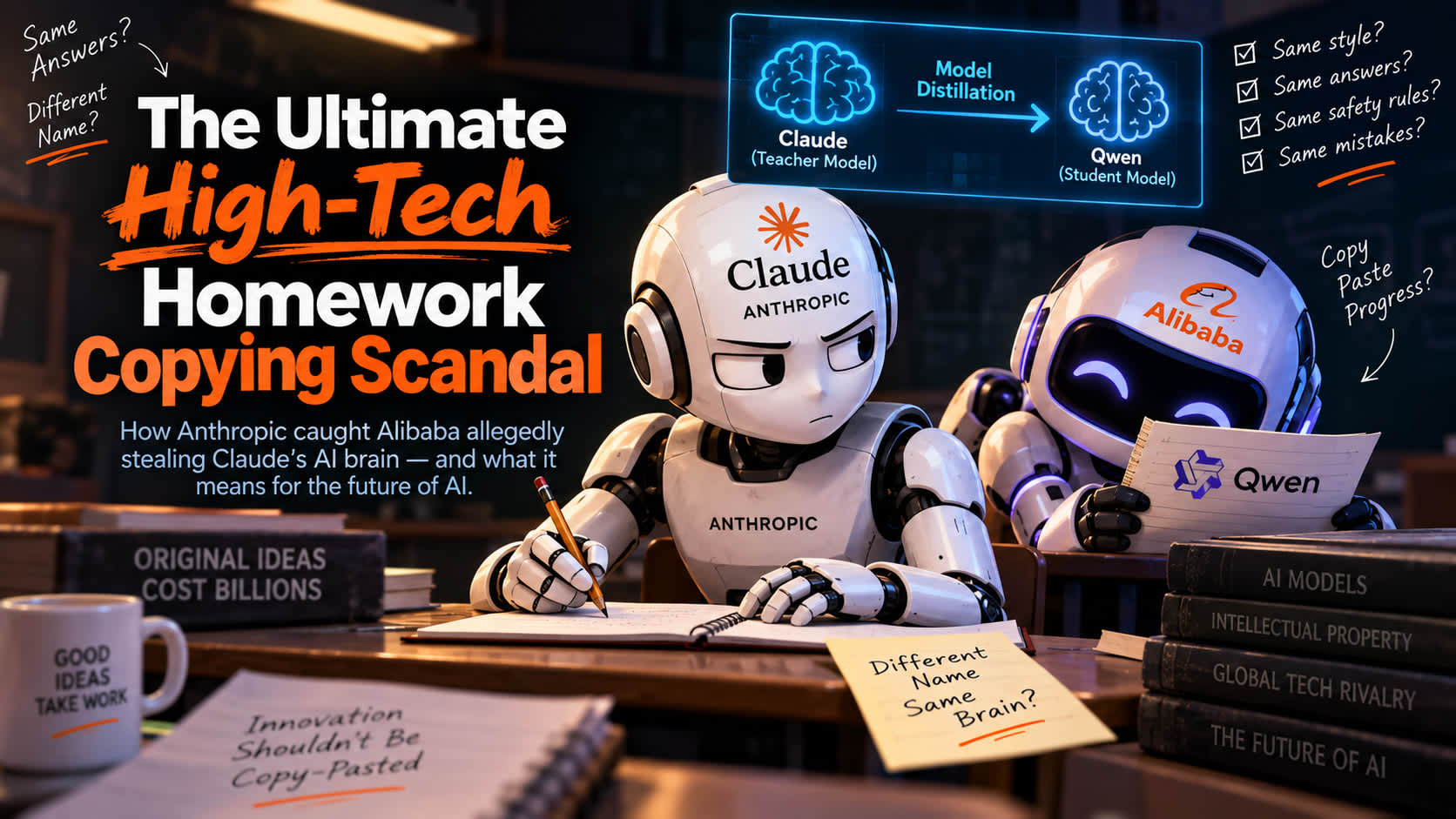
The Ultimate High-Tech Homework Copying Scandal
Remember school days when you forgot to do your homework, and you begged your smartest classmate to let you copy theirs? You promised to "change a few words so the teacher doesn't notice." Well, it turns out that multi-billion-dollar AI companies do the exact same thing. Only instead of a history essay, they are copying AI models that cost hundreds of millions of dollars to train.
The tech world is currently eating popcorn while watching a massive drama unfold: Anthropic, the creators of the incredibly polite and highly capable Claude AI, has accused Chinese tech giant Alibaba of illicitly extracting its AI capabilities to train their own model, Qwen.
But how do you actually "steal" the brain of an AI? You cannot just plug a USB drive into Claude and download its thoughts. Instead, engineers use a highly effective, legally gray, and incredibly cheeky technique called Model Distillation (or imitation learning). Let us break down how this heist happened, the technical mechanics behind it, and why Anthropic is so furious.
The Technical Art of "Model Distillation"
To understand the accusation, we need to understand how modern AI models are trained. Training a frontier model like Claude 3.5 Sonnet from scratch requires thousands of high-end GPUs, months of compute time, and a electricity bill that could power a small country. This is called pre-training.
However, if you are a competitor who wants to skip the expensive part, you can use a shortcut. You take a smaller, cheaper, "dumb" model, and you make it query the expensive model (Claude) millions of times. By analyzing Claude's highly sophisticated answers, your smaller model learns how to think, format, and reason just like Claude. In the industry, this is known as transferring knowledge from a Teacher Model to a Student Model.
Here is a basic conceptual example of how developers automate this distillation process using simple Python scripts to scrape a superior model's intellect:
import anthropic
import json

# The "Teacher" client (Claude)
teacher_client = anthropic.Anthropic(api_key="CLAUDE_API_KEY")

# A list of complex reasoning prompts we want our cheap model to learn
training_prompts = [
    "Explain quantum computing using an analogy of a spinning coin.",
    "Write a secure rust function to handle token validation.",
    "Solve this complex logical riddle step-by-step..."
]

dataset = []

# Extracting the "intelligence" of the teacher
for prompt in training_prompts:
    response = teacher_client.messages.create(
        model="claude-3-5-sonnet-20241022",
        max_tokens=1000,
        temperature=0.2, # Low temperature for highly structured, logical outputs
        messages=[{"role": "user", "content": prompt}]
    )

    # Saving the high-quality response to train our cheap model later
    dataset.append({
        "instruction": prompt,
        "output": response.content[0].text
    })

# Now we save this "gold standard" dataset to fine-tune our own model
with open("stolen_wisdom.json", "w") as f:
    json.dump(dataset, f, indent=4)
By running millions of these queries across diverse topics (coding, logic, creative writing, roleplay), the student model begins to mimic the exact style, reasoning steps, and safety guardrails of the teacher. You essentially get a world-class AI for a fraction of the price.
How Alibaba Got Caught Red-Handed
If model distillation is so quiet, how did Anthropic find out? Well, AI models have "fingerprints" and unique quirks. When you train a student model entirely on Claude's outputs, the student model accidentally inherits Claude's personality, system prompts, and even its mistakes.
There are a few hilarious ways AI companies catch competitors copying their models:
- The "Who Are You?" Trap: If you ask the copied model "Who made you?", it might forget its new name and answer, "I am Claude, a large language model trained by Anthropic." This happens because the training dataset was filled with Claude saying exactly that!
- System Prompt Leakage: Every AI has hidden instructions (system prompts) that tell it how to behave. If a student model starts using the exact, highly specific formatting rules of Anthropic's safety guidelines, it is a dead giveaway.
- Watermarking: Some companies inject subtle, invisible patterns or specific rare words into their model's outputs. If those exact rare words show up in a competitor's model, they are caught red-handed.
Why This is a Massive Deal
While copying homework is annoying, in the AI industry, it is a battle over survival and intellectual property. Anthropic spends millions on safety alignment (making sure the AI doesn't explain how to build weapons). If Alibaba can simply scrape those safe responses and inject them into Qwen, Alibaba gets all the safety benefits for free, violating Anthropic's Terms of Service which explicitly forbid using Claude's outputs to train competing models.
However, proving this in a court of law is incredibly difficult. Alibaba can claim that their model simply arrived at the same logical conclusions independently. After all, if two smart people write the same correct answer to a math problem, did one copy the other?
The Future of AI Copy-Paste
As long as frontier models are accessible via APIs, distillation will happen. It is the worst-kept secret in Silicon Valley. Almost every open-source model has been "boosted" using synthetic data generated by GPT-4 or Claude.
For consumers, this is actually great news because cheap, open-source models are getting incredibly smart, incredibly fast. But for the companies spending billions on research, it is a nightmare. The next time you use an AI and it feels strangely familiar, remember: it might just be Claude wearing a very clever disguise!