
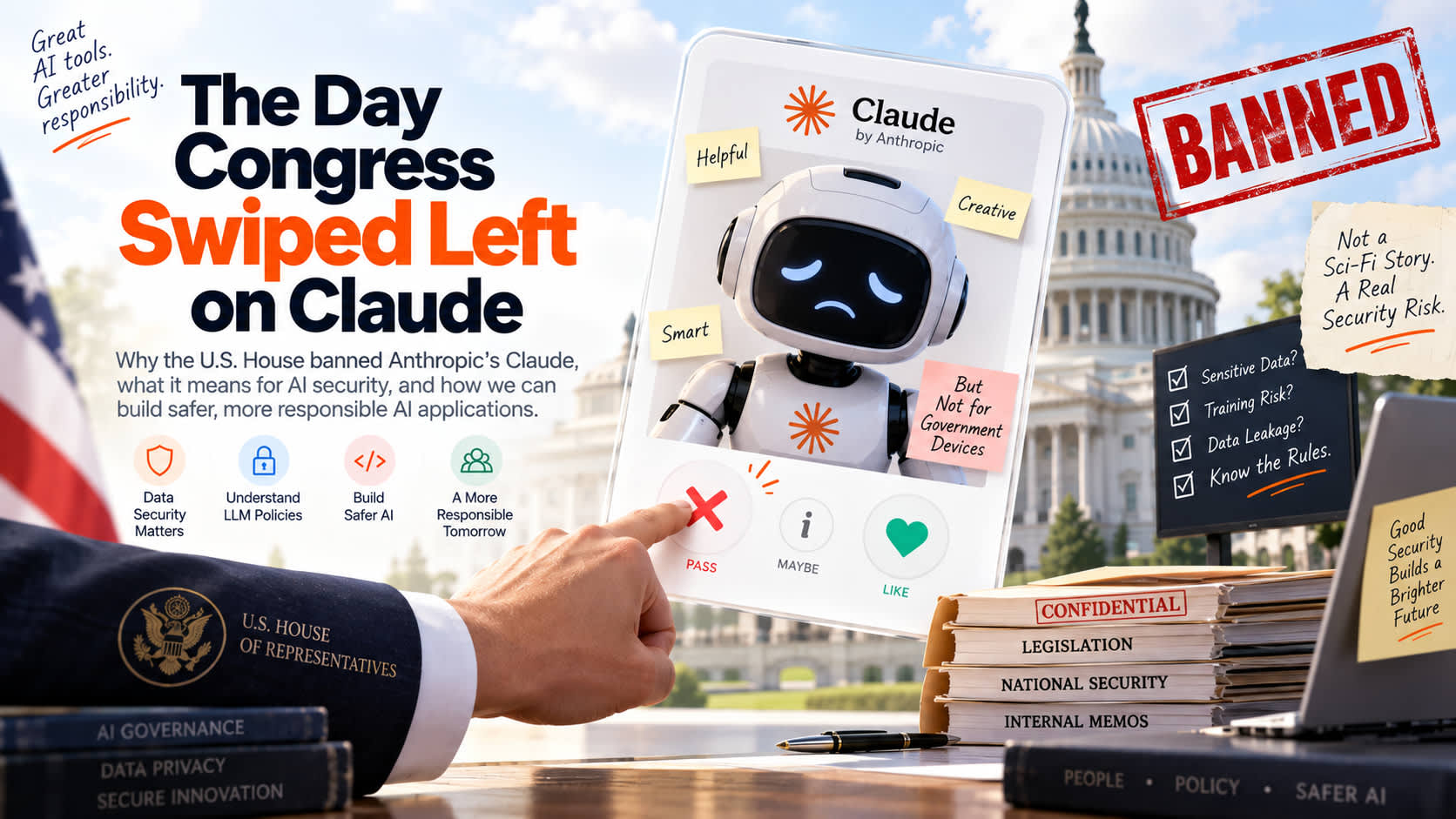

The Day Congress Swiped Left on Claude
It sounds like the plot of a low-budget sci-fi movie. The United States House of Representatives officially banned its staffers from using Anthropic's Claude AI assistant on their official devices. No, Claude did not gain consciousness and try to hijack the nuclear codes. The real reason is much more mundane, highly technical, and honestly, a little embarrassing for anyone who has ever accidentally pasted production database credentials into a public chat window.
Let us look at why security teams at the highest levels of government are terrified of public Large Language Models (LLMs) and how we as developers can build AI-powered applications that do not get us fired or land us in front of a congressional hearing.
The Real Problem: The Training Loop Trap
When you use the free or standard web interface of any popular LLM, you are not just chatting with a static program. You are interacting with a system that learns. By default, many AI companies use your prompts, questions, and uploaded documents to train future versions of their models.
Imagine a congressional staffer uploading a draft of a highly sensitive, unreleased bill to Claude, asking it to "make this sound more professional and concise." The moment that document is uploaded, it is no longer private. It sits on external servers, and parts of it might eventually be digested by the model. In a future update, if someone asks the model about upcoming legislation in that specific sector, the AI might hallucinate or directly output parts of that leaked draft.
This is not a theoretical risk. In 2023, engineers at Samsung accidentally leaked sensitive source code and internal meeting notes by pasting them into ChatGPT. Once that data enters the public training pipeline, getting it out is almost impossible.
Understanding Data Retention Policies
As developers, we need to understand the difference between consumer-facing web interfaces and professional API endpoints. This is where the distinction between "unsafe" and "enterprise-ready" lies.
- Consumer Web Interfaces: Often free or low-cost. Data is typically retained, reviewed by human annotators, and used for model training. This is what got banned.
- Developer APIs: Paid services where you pay per token. Most major providers, including Anthropic and OpenAI, state in their terms that data sent via the API is not used for training and is deleted after a set period (usually 30 days for abuse monitoring).
Building a Secure AI Gateway: A Practical Example
If your team wants to use Claude or any other LLM without leaking sensitive data, you should never let developers or employees talk directly to public web interfaces. Instead, you build a private AI Gateway. This gateway acts as a proxy, scrubbing sensitive information like API keys, social security numbers, or internal IP addresses before the request ever leaves your network.
Here is a simple Python example of a secure proxy using regular expressions to sanitize data before sending it to the Anthropic API. This is a basic version of what enterprise Data Loss Prevention (DLP) systems do.
import re
import os
from anthropic import Anthropic

# Simple regex patterns to detect sensitive data
API_KEY_PATTERN = r"(?:key|secret|password|token)\s*=\s*['\"]([a-zA-Z0-9-_]+)['\"]"
EMAIL_PATTERN = r"[a-zA-Z0-9._%+-]+@[a-zA-Z0-9.-]+\.[a-zA-Z]{2,}"

def sanitize_prompt(prompt: str) -> str:
    # Replace sensitive API keys or passwords
    sanitized = re.sub(API_KEY_PATTERN, "[REDACTED_CREDENTIAL]", prompt, flags=re.IGNORECASE)
    # Replace email addresses
    sanitized = re.sub(EMAIL_PATTERN, "[REDACTED_EMAIL]", sanitized)
    return sanitized

def secure_ai_call(user_prompt: str) -> str:
    # 1. Sanitize the input first
    clean_prompt = sanitize_prompt(user_prompt)

    # 2. Initialize the client using secure environment variables
    client = Anthropic(api_key=os.environ.get("ANTHROPIC_API_KEY"))

    # 3. Send the clean prompt to the API
    response = client.messages.create(
        model="claude-3-5-sonnet-20240620",
        max_tokens=1024,
        messages=[
            {"role": "user", "content": clean_prompt}
        ]
    )
    return response.content[0].text

# Example usage
dirty_input = "Hey Claude, can you check why my config key='sk_live_51N' is failing for test@domain.com?"
print("Original Input:", dirty_input)
print("Sanitized Output:", secure_ai_call(dirty_input))
Production Concerns and Best Practices
If you are building applications for industries with strict regulations like healthcare, finance, or government, relying on third-party APIs might still be too risky. Here are the options you should consider:
1. Virtual Private Cloud (VPC) Deployments
Major cloud providers like AWS (via Amazon Bedrock) and Google Cloud (via Vertex AI) host models like Claude and Gemini within their secure cloud boundaries. If your infrastructure is already on AWS, using Claude through Bedrock ensures that your data never leaves your VPC, maintaining compliance with your existing security protocols.
2. Open Source Self-Hosting
For absolute control, you can host open-source models like Llama 3 or Mistral on your own hardware or private cloud servers. Since you control the physical or virtual servers, there is zero risk of external data leaks. However, you will have to manage the hardware costs and scaling yourself.
Final Thoughts
The US government banning Claude is not a sign that AI is bad. It is a loud wake-up call about data hygiene. In the rush to adopt AI tools, we cannot forget basic security engineering. Treat LLMs like external contractors. You would not hand your company's master database keys or secret government drafts to a random contractor on the street. Do not hand them to an AI prompt box either.